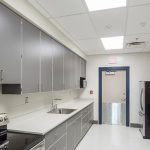
Pharmaceutical facilities live and fall by contamination control. The right wall system determines how reliably a lab clean room holds its classification, how quickly teams can sanitise between batches, and how consistently audits pass.
This guide explains why specialist cladding in pharmaceutical industry settings is mission-critical, compares common panel options, and outlines how Kleenclad’s hygienic system supports validation, cleaning SOPs, and lifecycle performance without inflating risk or cost.
Why walls define clean room outcomes
Air handling gets attention, but wall continuity decides whether corners, joints, and penetrations become particle traps. Traditional paints scuff and micro-crack under harsh disinfectants. Tiles fail at grout, where residues and moisture linger.
Specialist wall systems use smooth, non-porous surfaces with sealed or welded detailing, so a lab clean room remains stable during frequent disinfectant rotations and routine inspections.
What to demand from cladding in the pharmaceutical industry
- Seam-minimised geometry that removes harborage points at joints, corners, and skirtings.
- Non-porous, low-texture surfaces that withstand oxidising agents, QACs, alcohols, and periodic sporicidals when used as directed.
- Built-in antimicrobial surface protection that helps reduce microbial load on the panel surface throughout the product’s life, while complementing routine cleaning.
- Fire performance documentation suitable for interior pharmaceutical applications, with clear and current test reports.
- Method statements and installer training that produce consistent outcomes across rooms, expansions, and shutdowns.
Material landscape for lab clean room walls
PVC hygienic panels
Seam-minimised systems with thermoformed corners and coved skirtings deliver smooth, continuous surfaces. Chemical resistance supports frequent disinfectant cycles. Integrated silver-ion technology provides built-in surface protection that helps inhibit microbial growth and remains effective even after normal use.
HPL and compact laminates
Robust and impact-resistant, suitable for corridors, change rooms, and less critical zones. Confirm compatibility with aggressive agents in Grade C and D environments and validate edge detailing near sinks or pass boxes.
Stainless steel
Excellent for high-wear or direct chemical exposure zones. High material cost and visible abrasion can complicate appearance and cleaning at scale. Use selectively where justified by process risk.
Sandwich and modular panels
Useful for speed of build and future reconfiguration. Focus on joint integrity, gasket performance, and interface details with ceilings, floors, and pass-throughs to maintain airtightness and cleanability.
Design details that pass audits
- Airtight joints and penetrations: Seal interfaces at view panels, conduits, and pass boxes.
- Internal and external corners: Prefer thermoformed or continuous trims to avoid caulk-dependent edges.
- Floor-to-wall transitions: Coved skirtings prevent pooling and ease mop paths.
- Service access: Plan removable sections for maintenance without cutting onsite, which can create particulates.
Cleaning and compatibility in cladding in the pharmaceutical industry
Validation teams expect stable surfaces across disinfectant rotations. Specify compatibility with alcohols, peroxides, QACs, and sporicidals at defined dilutions and temperatures. Surfaces should resist whitening, softening, or micro-cracking.
Written cleaning guidance that includes contact times and rinse protocols helps standardise results across shifts and contract housekeeping vendors.
How does Kleenclad strengthen every lab clean room?
Seam-minimised hygiene by design
Panels, trims, and thermoformed corners create continuous surfaces that clean fast and reduce deviation risks at edges and interfaces. This supports consistent particle counts and visual inspections during line clearance.
Built-in antimicrobial surface protection
Integrated silver-ion technology helps reduce microbial load on the panel surface for the product’s lifetime. It complements existing SOPs and does not replace cleaning or disinfecting. Language is conservative and aligned with good practice for regulated spaces.
Chemical and moisture resilience
Surfaces maintain integrity under frequent disinfectant use and wet cleaning. This reduces early refurb cycles and keeps walls within appearance and function criteria across audits.
Validation support and aftercare
Clear method statements, installer guidance, and cleaning compatibility documentation give QA and engineering teams the artefacts they need for qualification, change control, and routine CAPA reviews.
Specification checklist for transactional decisions
- Classification and zoning: Map panel types to Grade B through D rooms, change areas, and support corridors.
- Substrates and moisture: Verify substrate condition, primers, and adhesives appropriate to humidity and temperature cycles.
- Interfaces: Detail joints, corners, pass boxes, windows, and utility penetrations with approved solutions.
- Fire documentation: Request current, relevant test data aligned to interior use cases.
- Cleaning guidance: Confirm approved agents, dilution, maximum temperatures, and rinse requirements.
- Training and warranty: Choose partners who train installers and stand behind workmanship with responsive support.
Why is Kleenclad the practical choice for India?
Kleenclad is built for regulated environments where uptime, hygiene, and audit readiness matter every day. The system combines seam-minimised detailing, built-in antimicrobial surface protection, and chemical resistance to help keep walls stable through batch cycles and shutdowns.
With installation discipline and documentation, engineering and QA teams gain a reliable path to cleaner surfaces, predictable maintenance, and confident inspections.
Conclusion
In modern pharma, specialist cladding in pharmaceutical industry settings is not a decorative decision. It is a core control that shapes contamination risk, cleaning time, and audit outcomes in every lab clean room. By prioritising seamless geometry, validated cleaning compatibility, and conservative antimicrobial claims that complement SOPs, facilities secure consistent performance.
Kleenclad aligns with these priorities, delivering durable walls, robust detailing, and the service support needed to keep Indian clean rooms compliant and operational.