Educational buildings handle dense foot traffic, shared surfaces, and frequent cleaning cycles. Facility teams evaluating hygienic wall cladding for school settings need surfaces that resist wear, simplify sanitation, and remain stable under daily use.
This guide outlines how modern systems improve health outcomes, compares material choices for classrooms, labs, washrooms, and cafeterias, and clarifies why Kleenclad’s solution is engineered to meet operational realities across Indian schools and universities.
Why wall hygiene matters in education?
Crowded corridors, labs, and canteens place continuous stress on wall finishes. Conventional paints scuff and peel with repeated washdowns. Tiles fail at grout lines, where soils and moisture linger. Seam-minimised, non-porous wall cladding for education institution environments helps reduce microbial harborage and keeps cleaning predictable across terms and holiday maintenance windows.
What defines effective hygienic wall cladding for schools?
- Non-porous, smooth surfaces that clean quickly and do not trap soils.
- Seam-minimised detailing with coved skirtings and thermoformed corners to remove dirt traps.
- Chemical resistance to common school cleaning agents, including neutral and alkaline detergents and oxidisers, when used correctly.
- Built-in antimicrobial surface protection that helps reduce microbial load on the panel surface over the product’s life and complements routine cleaning.
- Clear fire performance documentation and installation method statements that support compliance in Indian educational projects.
Material choices compared for wall cladding for an educational institution
- PVC hygienic panels: Seam-minimised systems deliver smooth, crevice-light walls suited to classrooms, libraries, labs, canteens, and hostel washrooms. Integrated silver-ion technology provides continuous, built-in surface protection and does not rely on post-application coatings.
- Compact laminate and HPL: Impact-resistant and available in calm, education-friendly finishes. Assess steam and chemical exposure in washrooms and labs to confirm long-term performance.
- Ceramic tiles: Familiar and durable tiles can be serviceable in select areas, but grout lines require intensive upkeep and periodic rework that disrupts academic schedules.
- Stainless steel: Best for local splash zones in kitchens and lab prep areas. High cost and abrasive wear make it a targeted rather than whole-building solution.
- FRP panels: Economical, but resin chemistry, finish smoothness, and bond integrity under frequent cleaning need careful verification.
Priority zones in schools and universities
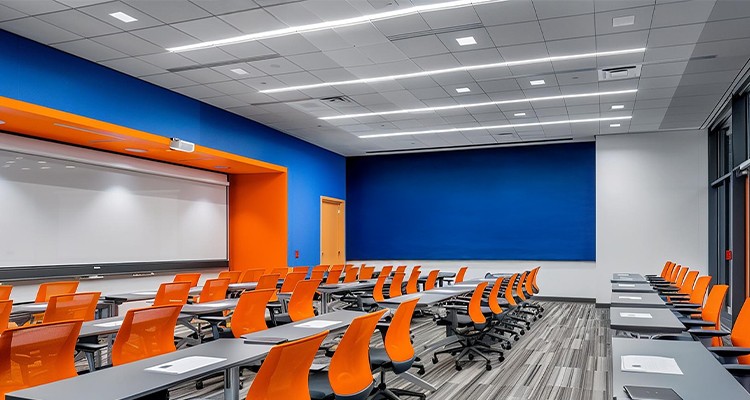
- Classrooms and corridors: Smooth, low-gloss surfaces resist scuffing and allow faster wipe-downs between sessions.
- Laboratories: Chemical-resistant finishes and sealed joints limit absorption and simplify spill response.
- Washrooms and hostels: Moisture-stable, non-porous panels reduce mould risk and tolerate regular disinfectant cycles.
- Canteens and central kitchens: Pair stainless steel near direct heat with hygienic panels elsewhere for durability and cost efficiency.
- Libraries and admin: Low-maintenance surfaces retain appearance and reduce lifecycle touch-ups.
How does Kleenclad elevate hygienic wall cladding for schools?
- Seam-minimised hygiene by design: Panels, trims, and thermoformed corners provide seamless surfaces throughout extensive areas, saving cleaning time and inspection failures.
- Inherent antimicrobial protection: Integrated silver-ion technology assists in deterring microbial growth on the surface over the entire life of the product. It supplements current SOPs and is not a replacement for cleaning.
- Chemical and moisture resistance: Surfaces retain their integrity under regular sanitisation, preventing peeling, swelling, or staining that requires early refurbishment.
- Visual serenity, long-lasting finishes: Gloss and matt alternatives accommodate age-suitable colour schemes, minimise classroom glare, and retain appearance term after term.
- Lifecycle value: Lower rework than paints and tiles, predictable cleaning cycles, and fewer disruptions help protect academic schedules and operating budgets.
Procurement checklist for wall cladding for an educational institution
- Substrate readiness: Evaluating the substrate includes assessing moisture, bonding, and flatness. Approved primers and adhesives must be used throughout all phases of the project.
- Jointing Details: Joint details guide whether the joints are to be sealed, welded, whether there are internal and external corners, or whether coved skirtings are proposed.
- Cleaning guidance: Cleaning will include the manufacturer’s instructions and verifying compatibility with the school’s approved detergent and disinfectant, including dilution rates and maximum water temperatures.
- Fire documentation: Request current test reports and ensure alignment with interior project class requirements.
- Training and service: Prefer suppliers who offer installer training, method statements, and aftercare support.
Compliance and risk management
Schools and universities need solutions that align with hygiene, safety, and facility upkeep targets without inflating operational complexity. Transparent claims, conservative antimicrobial language, and documented cleaning compatibility help governance teams approve specifications with confidence.
The object is not to promise absolute safety, but to provide stable, cleanable surfaces that make routine sanitation effective and repeatable.
Why is Kleenclad the practical choice for India?
Kleenclad is targeted at controlled environments where uptime, cleanliness, and longevity need to intersect with budget. The antimicrobial surface protection inherent to the system, chemical resistivity, and seam-reduced detailing provide a compelling match for classrooms, laboratories, canteens, and dwellings.
With disciplined installation and straightforward aftercare, facility teams have a reliable means to cleaner walls and reduced mid-term disruptions.
Conclusion
Investing in hygienic wall cladding for school settings is a long-term decision that influences attendance, maintenance cycles, and audit outcomes. Seam-minimised surfaces, built-in antimicrobial protection that helps reduce microbial load, and compatibility with everyday cleaning form the basis of resilient educational interiors.
Kleenclad delivers these fundamentals with a focus on performance, installation quality, and lifecycle value, helping Indian institutions maintain safer, cleaner spaces across the academic year.